Showing posts with label from the front lines. Show all posts

5.22.2013

From the Front Lines: What to Write, What to Say


One way to be on the front lines with someone is to tell them.

Tell them you feel sorrow at their grief.

I learned that this is helpful because of how I felt when people left notes of encouragement and support on our Caring Bridge blog or when someone handed me a handwritten note or when someone said just the right words; however, when someone we know is struggling with a trial, it can be difficult to know what to say. Sometimes it feels so difficult that we say nothing at all for fear of saying something offensive or trite. After having struggled in a more public way with Claire’s illness and having many, many people write or say wonderful things, I’d like to share some ideas with you on what you can write or say to someone you love who is even now walking a difficult path. I offer my suggestion in bold, and then exact examples of words people wrote to our family.

Express your own faith in prayer, in God, in Christ:

1.       “My heart is aching for you right now, but I know that prayers are helping and that you are not alone in this battle. God does heal and He does make miracles happen.”
2.       “We love you and have so much faith in Christ and in Claire's recovery.”
3.       “I know that we learn from these challenges and gain strength we never knew we had, often after we pass through the most difficult part. I know the Lord will be there for you during the difficult days ahead.”
4.       “We fasted and prayed for your family today and I felt a peace in my heart for you.”
5.       “If this is what Heavenly Father wants you to be doing right now, then He will be sure to hold your hand through all of this.”

Express confidence in their faith and ability to overcome:

1.       “It is amazing to see such a strong spirit in Claire. I know I would not be that happy.”
2.       “My prayers are with you! Claire is one of those special little ones in this world. She's strong, happy and beautiful and we will all learn by watching the healing power of the priesthood and the hand of the Lord to heal her.”
3.       “It is so hard to know why our children have afflictions come upon them and it's heartbreaking to see them suffering. It's comforting to know that there is a reason and a purpose grander than we can understand to all of this. One day you will understand why but in the meantime you are doing all the right things. The Lord will not leave you in your time of need!”
4.       “Thanks for sharing your testimony and all the insights you are receiving. Your faith strengthens mine.” 
5.       “You can do this!”

Offer help:

1.       “We stand at the ready for anything you may need!  Babysitting?  It's what I do best :)”
2.       “Please know we are here for you in any way you may need.”

Offer a quote that comforts you:

1.       “Sometimes God calms the storm... Sometimes, He lets the storm rage and calms the child.” 
2.       “There are those among you who, although young, have already suffered a full measure of grief and sorrow. My heart is filled with compassion and love for you . . . Though it may seem that you are alone, angels attend you. Though you may feel that no one can understand the depth of your despair, our Savior, Jesus Christ, understands. He suffered more than we can possibly imagine, and He did it for us; He did it for you. You are not alone.” – President Uchtdorf
3.       “Today is ours to live, but His to control . . .”

Write to them the words you are using in your prayers for them:

1.       “We are also praying for your parents and other family members that they will have the health, strength and courage they need to help you get better.”
2.        “We will be thinking of you all through this difficult time and pray that you will feel peace and know that Heavenly Father is in control.”
3.       “May our Heavenly Father continue to hold your family in His arms and may you continue to feel the angels around your own little angel as she progresses with her treatment and all else that might be required of her.”

Express your own sadness that they are struggling:

1.       “We are stunned by your news but totally inspired by your response, your faith and your courage. You are in our prayers and thoughts.”
2.       “The news is quite heartbreaking, but I'm glad to hear that the prognosis is promising. She has loving, strong parents too!
3.       “This news made my heart hurt and I am so sorry for this to have happened to your sweet family!  Know that our prayers and thoughts will be with your family.  We love you guys.”  

Tell them you are praying for them:

1.       “We LOVE you guys.  Our kids are making Claire a permanent part of our daily prayers.  We'll be joining in the fast this weekend as well.”
2.       “We are thinking of you and praying for your comfort and strength.”
3.       “We are praying for you daily.  Every time we mention Claire, my little girl is sure to say "Claire is sick...pray".  I'm sure the faith of these little children, Claire included, will be the driving force to recovery.”

Tell them you are sharing in the challenge:

1.       “If I could possibly take this challenge away from you and endure it myself, I would.  But since that is not how it is supposed to be, we will all endure this together.”  
2.       “Look around and know you are adored and appreciated.  We are all with you.”
3.       “I wish I could hug you right now and give you a little break. I hope you know that we care enough to hear when things are not so great. Thanks for posting.”

Even now, months away from Claire’s complete recovery, these words mean something deep to me. I treasure them and am so glad that the people who wrote them had the courage to share them with me. I learned from these very supportive friends, family members, and in some cases, strangers.

Caring words written or said in love are medicine for the injured soul.

3.29.2013

An Unspoken Prayer: Evolution of a Friendship


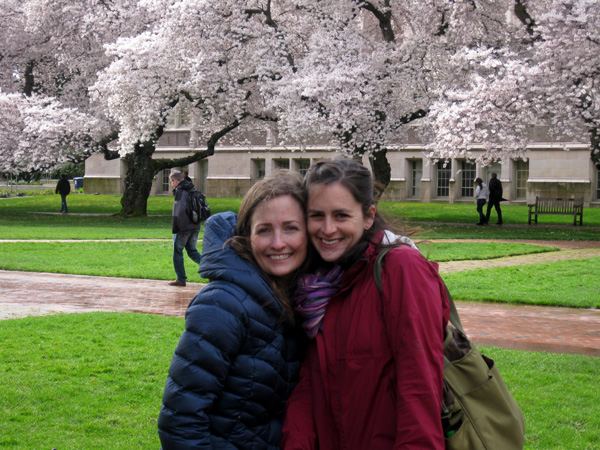
Tenley and me at the cherry blossoms last year - 4 years into a lifelong friendship.

Why is Kathy holding that baby? I think to myself as I see my slight, blonde friend swaying back and forth with a baby I’ve never before seen.

“What’s with the baby?” I prod as I come up beside her.

“Oh, hi,” Kathy shrugs, “Tenley is giving a talk today and she asked me to hold Troy.” She nods down at the baby boy in her arms. He looks to be about 3 or 4 months old.

Who is this poser Tenley? Why would she ask my friend Kathy for help? I’m the one with a baby, not Kathy. I feel a prick of jealousy, but I don’t want to let on that I have no idea who Kathy’s talking about. She obviously thinks I know this Tenley.

A few weeks later, at a church gathering, I see Tenley sitting at one of the concrete picnic tables with her husband and baby boy. People are milling around but no one has snagged the seat next to Tenley and her family. I whisper to Dustin, “We should go say hi to that new couple.” We are quick to welcome new comers, so Dustin doesn’t think this is out-of-the-ordinary. I am, however, partly fueled by the desire to know whomever Kathy knows. I don’t want to be left out in case she’s moving on to new friendships. After a slightly awkward introduction, we move away politely.

Months later, it seems that I haven’t seen Tenley at church, or elsewhere for that matter, so when she calls me, I am surprised.

“Hi Sally. This is Tenley.”

I haven’t forgotten her unusual name, so at least I don’t embarrass myself by asking, “Who?” Instead I talk with her like we’re friends. After we exchange the normal niceties, she asks if I know anyone who would like to do a babysitting exchange with her. She’s an apartment manager, as am I, and needs a babysitter for a couple of hours a week to complete her management tasks.

Why does this girl even care? The job is lame. It’s not like it has to be done well, I think. Then I surprise myself when I hear something else coming out of my mouth: “I would love to do a babysitting exchange with you! I could use a few hours a week to take care of our apartment building as well.”

I can feel the look on my face questioning my words. After all, my face knows better. I don’t like babysitting. The only child I love is my own.

The babysitting exchange is born. Tenley drops 6-month-old Troy at my apartment on Tuesday mornings for 2 hours, and I pick and choose between various mornings, afternoons, and sometimes I opt for a date night babysitting trade instead. Usually it’s pretty easy besides the fact that Troy never will hold his own bottle so sometimes I have to juggle feeding Troy a bottle and nursing Claire. Other than that Claire and Troy enjoy watching each other and over time, they begin to play.

Because the kids like each other well enough, and because we have something in common (apartment managing) we decide to try a play date where we all hang out for a morning. I’ve never really hosted a play date and the only one I’ve ever been to, the mom served us all a gourmet lunch. I’m not sure what protocol is so I decide I should serve lunch, too. I open a can of soup and then try to make lunch seem a little more gourmet by broiling the ham and cheese sandwiches. Tenley only eats about half of the lunch and leaves early because Troy is fussy. I figure we should just stick to the babysitting exchange. We don’t really need to be friends. The set-up we have works. Why force more?

Before long, we’re hanging out every week. Then Tenley asks all of us to come to dinner. Then we ask their family to come to dinner.

Suddenly I realize that Tenley has become my best friend.

Later, Tenley says something in passing that makes me wonder if something is wrong. I don’t get the chance to ask her about it. It stews in the back of my mind. I can tell by the way she mentioned it that she doesn’t actually want to talk about it, but I can’t stop thinking about her. I should have at least asked her if she wanted to talk about whatever is bothering her.

I'm picking Claire up from an afternoon at Tenley’s. I’m 8 or 9 weeks pregnant with Avery (baby number 2) and feeling nauseous. I think I’ll just dash in to get Claire then hurry home to make dinner. My morning (day) sickness begs to be fed often and dinner time is no exception. When I get down on the floor to pick up Claire’s various socks, shoes, and stuffed animals, I remember that I should tell Tenley that we can talk about whatever is bothering her any time, so I do. She resists, but I push just a little, and then we really talk. I talk through the nausea because all that matters is that Tenley needs me. I have the thought that this moment in our friendship is probably one of the reasons I introduced myself at the party and then said yes to babysitting her baby.

Even if it was just so we can have this important conversation today, it is enough.

A little over a year and dozens of playdates later, my beautiful Claire is diagnosed with Leukemia. My world shatters and amongst the pieces I find wonderful friends. Tenley and her family are the first visitors to the hospital. She immediately seems to have a great respect for Claire’s new immunity problems. I know she won’t visit if she or Troy has the sniffles or a scratchy throat. I trust her. She calls me every couple of days just to check in. She seems to understand when I shut down socially.  

One day when we can’t go anywhere because of Claire’s compromised immune system, Tenley and Troy give us a ‘heart attack.’ We watch them through the large living room windows. They tape colored, paper hearts all over the window. Some are covered with obvious Troy scribbles. Some have happy writing from Tenley. Still others have photos of Claire and Troy from our camping trip earlier in the summer. I ache to be helping them heart attack someone else. I wish fervently that we didn’t need it, but try to enjoy it just the same.

Later, when Claire has to be hospitalized, I arrive home from the hospital to take the night shift at home with Avery. I get home late and exhausted. I eat a dark, lonely dinner. Less than half an hour later, there is a soft knock at the door. It’s Tenley. She’s holding two cups of Starbuck’s hot chocolate. With the liquidy chocolate, she offers her company and a listening ear if I need one. I accept them all gratefully.

Now, a couple of years from that moment of crisis, I think back to the beginning of a friendship. I think of the playdates, the babysitting, the shared meals and outings. I think of my fatigued heart with blood continuing to pulse painfully even though I would much rather be dead. And, I think of the relief a friend can bring. I assume Tenley thinks I was an answer to her prayer when she moved to Seattle with a newborn and some challenges of her own, but I know better.

Tenley was the answer to a prayer I had not yet prayed.

10.30.2012

From the Front Lines


When the Unthinkable Happens to You: 7 Things That Helped Me

     source

Discovering Claire’s cancer was one of the most pivotal moments of my life. I had so many thoughts, one of which was, “Things like this don’t happen to me.” I’m sure others have had this thought when faced with an insurmountable challenge. If you are one of those people, or if you will be someday, here are a few things that I’ve learned:   

1.     Find gratitude for whatever makes it ‘enough’:

“Gratitude unlocks the fullness of life. It turns what we have into enough, and more.” - Melodie Beattie

Throughout Claire’s treatment, when I was feeling grateful, everything seemed to be better than it actually was. Instead of feeling angry about Claire’s disease, I felt grateful that we only lived 3 miles from one of the best children’s hospitals in the nation. Instead of feeling cramped when my mother-in-law, then sister, lived with us in 1200 square feet of space for a combined 12 weeks during those first 6 months, I felt grateful that they were both willing and able to serve us. Instead of being angry with God, I felt grateful that He trusted that I could endure the trial and become better. Gratitude made whatever I had at the time enough.

What can you find to be grateful for? Cling to it with all that you are, and ask in prayer for help to see any good thing.

2.     Let it go:

The idea that you have a normal life is over. At one point during the most intense parts of Claire’s treatment, I looked down at the kitchen floor. I was flabbergasted at what I saw. LAYERS of food caked the linoleum under the table. With a toddler and a baby, it was probably only 3 or 4 days worth (okay, maybe a week), but it was disgusting. Despite the gross factor, it had to be okay. I had been at the hospital everyday with Claire that week for rounds of chemo. I had to let go of any embarrassment I felt that the babysitter saw my house like that because . . . it didn’t matter. Not that week. I give you permission to stop cleaning your house, or whatever it is that falls to the bottom of your priority list.

3.     Ask for help:

If something really overwhelming has appeared in your life, then something else will have to give. It might be your normally clean house as was my case. It might be yard care, or car maintenance, or bill paying. When we initially came home with Claire from the hospital, Dustin and I both panicked that some germ lurking somewhere would make her sick enough to be hospitalized. This was a real concern. Claire’s immune system was completely gone. I worked up the courage to ask my visiting teachers to organize a cleaning group to come to my house to sanitize every single surface – door knobs, window tracks that might have harmful mold, every wall and ceiling, furniture, cabinets inside and out, etc. It was a big job that would have felt too overwhelming for me to tackle on my own in those front line days. A group of 6 or 7 women came and took the house by storm. It was amazing. Ask.

4.     Take Control:

I heard the words, “Let me know what I can do” many, many times in those first weeks and months. I usually didn’t have an answer for them. I knew that the offer was sincere, but I didn’t know how to ask for help. Dustin on the other hand was an expert. If someone said that to him, he always gave them an assignment right away. He asked for yard care, babysitting, dinners on clinic days, etc. If you asked, Dustin had something for you. Most often, I was the benefactor of his requests. I learned a great lesson from that. Although it doesn’t feel that helpful when someone says, “Let me know if I can help,” it can be, if you decide it is.

Make a list of things that someone else could do. Keep the list in your pocket. When someone asks what they can do to help, and they will because they don’t know what you need, pull out your list and give them an assignment.

5.     Accept your circumstances:

Denial helps no one, especially not you. One time, when Claire was hospitalized for neutropenia, we roomed with two teenage boys. One had a cancer that was requiring severe rounds of chemo and radiation to shrink the tumor. The other had an ongoing blood issue since childhood. He’d been hospitalized repeatedly since he was a toddler. It was easy to think we were more fortunate than they were – to downplay our own difficult circumstances. DO NOT DO THIS. Comparing gets you nowhere. Recognize your own difficulties and do what you can to make them better. Just because someone else seems to have it worse off than you, that doesn’t mean you don’t also feel overwhelmed, frustrated, pained, sad, angry, etc. Your feelings are legitimate. Be honest about them.

6.     Shrink Your To-do List:

Make your list like you normally would. Then read it once. Then throw it away. You don’t have to do any of those things. Maybe everyone knows of your difficulties so it’s easy to do this. Like when I would apologize to someone for not calling them back in a timely manner. Their response was almost always, “No worries. You’ve got a good reason.” They were of course referring to Claire’s Leukemia. In many ways, this made it easy for me to have lower expectations for myself. But, what if your difficulty is private, but just as consuming? You still need to learn to say, “No.” You can’t do the fundraiser. You can’t help with the wedding. You can’t volunteer for the Christmas play. No one needs to know why.

7.     Confide in a Friend:

For me, this was most often the Caring Bridge blog we wrote to keep friends and family informed. Just writing the words helped me to gauge where I was and how we were doing, but a thousand times better were the comments and emails that would come after we had posted an update. It was proof that someone cared. Someone was listening. Someone else was hoping and praying for us to succeed. Other times, it was confiding privately to a good friend. If your difficulty is not something you can share publicly, I encourage you to find one friend who can keep a secret. A friend who can listen and not judge. A friend who loves you.

Hint: If you are not currently ‘on the front lines,’ I encourage you to BE the friend for someone who is. Believe me, it will come back to bless you tenfold.

What has helped you when you are hunkered down in the midst of challenges? I’d love to know. 

See this post for advice for those of you who want to help someone who is currently on the front lines.